
In the rapidly evolving world of digital marketing, the debate between google programmatic advertising and traditional ad buying is more relevant than ever in 2026. As technology reshapes how brands connect with consumers, marketers face critical choices on where to invest for maximum impact.
This article dives deep into the core differences, unique advantages, and key challenges of google programmatic advertising versus traditional ad buying. By understanding both strategies, you can make smarter decisions for your next campaign.
We will break down definitions, mechanics, benefits, drawbacks, practical examples, and emerging trends. Ready to unlock actionable insights and find clarity for your advertising strategy? Let’s explore which approach is best for your business needs.
Understanding Google Programmatic Advertising in 2026
In 2026, digital marketers are witnessing an era where automation, data, and technology converge to redefine advertising. Google programmatic advertising now sits at the heart of this transformation, offering brands unprecedented ways to connect with audiences across multiple channels.
The Evolution of Programmatic Advertising
Since 2020, google programmatic advertising has evolved rapidly. Automation and artificial intelligence have become foundational, making ad buying faster and smarter. Machine learning algorithms now optimize bids and placements in real time, driving better outcomes for advertisers.
What began as a tool for display ads has expanded into connected TV (CTV), digital audio, digital out-of-home (DOOH), and seamless cross-device targeting. Real-time bidding (RTB) powers instant ad placements, allowing advertisers to reach users at the perfect moment.
Programmatic’s open ecosystem contrasts with walled gardens, offering access to millions of sites and apps. For example, a single campaign can reach users browsing news, streaming music, and watching smart TV content. By 2026, global programmatic ad spend is projected to surpass previous records, reflecting its dominance in the digital space. For a deeper dive into this evolution, see Programmatic advertising’s evolution and impact.
Core Components and Workflow
The backbone of google programmatic advertising is its interconnected platforms:
- Demand-Side Platforms (DSPs): These tools allow advertisers to buy digital inventory across multiple exchanges.
- Supply-Side Platforms (SSPs) and Ad Exchanges: Publishers use SSPs to make their ad space available, while ad exchanges facilitate the buying and selling process.
- Data Management Platforms (DMPs): DMPs segment and manage audience data, enabling highly targeted campaigns.
The real-time auction process starts when a user visits a site. The DSP analyzes available data, makes a bid, and, if successful, serves the ad instantly. Programmatic Direct and Private Marketplaces (PMPs) offer guaranteed deals and premium inventory, blending automation with strategic buying.
A typical workflow might involve using a DSP to combine first-, second-, and third-party data for precise targeting. In 2026, a significant share of programmatic transactions will occur via PMPs, reflecting demand for both automation and quality inventory.
Key Benefits of Google Programmatic Advertising
Google programmatic advertising offers unmatched scale and inventory diversity. Brands can access the open web, CTV, audio, and DOOH from a single platform. Advanced targeting leverages diverse data sources, facilitating personalized messaging for each audience segment.
Dynamic creative optimization ensures the right message is delivered in the most engaging format, whether it’s a native ad or an interactive video. Real-time analytics empower marketers to adjust campaigns instantly, improving performance and efficiency.
Cross-channel measurement provides unified reporting, making it easier to assess multi-platform campaigns. For example, a brand awareness campaign might use CTV and native ads to achieve broad reach and high engagement. In 2026, a majority of marketers report improved return on ad spend (ROAS) from programmatic, highlighting its value in today’s digital landscape.
Traditional Ad Buying: Principles and Practice
In the fast-shifting advertising landscape, the contrasts between traditional ad buying and google programmatic advertising are sharper than ever. Marketers must understand the core mechanics of traditional approaches to make informed choices in 2026.
What is Traditional Ad Buying?
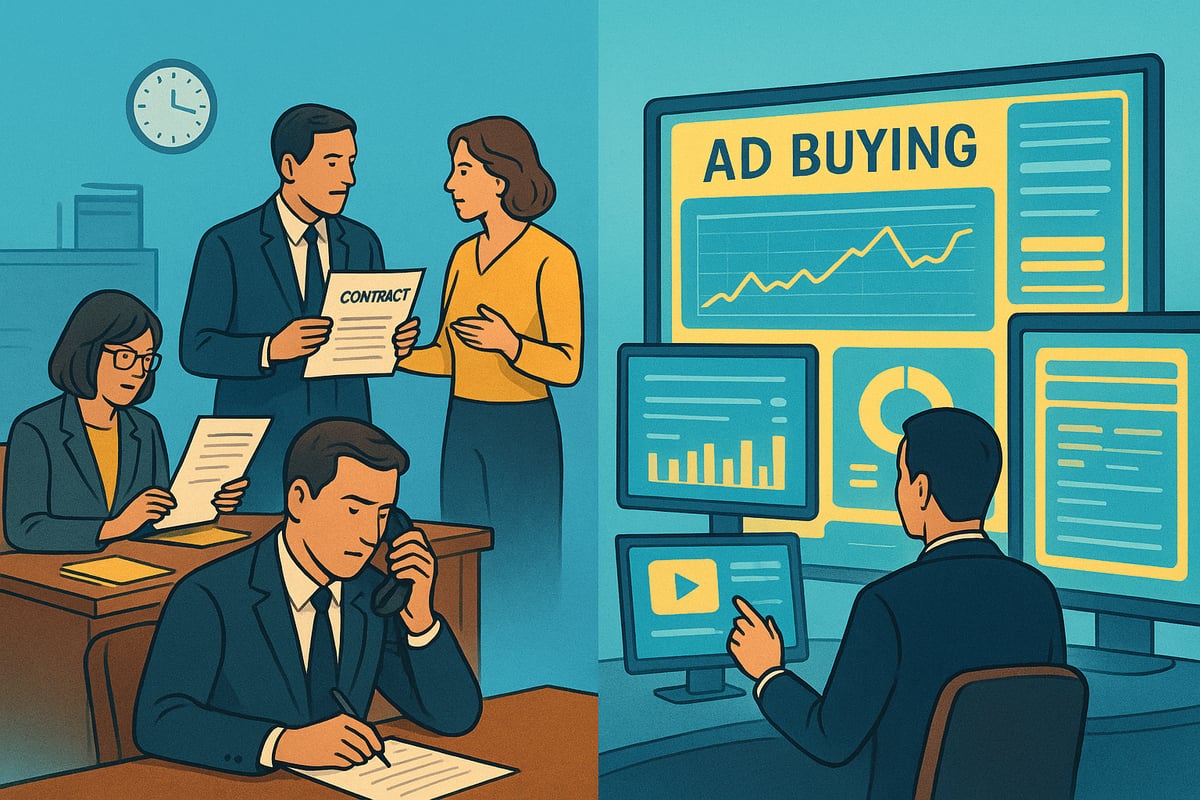
Traditional ad buying refers to the manual negotiation and purchase of advertising space across channels such as print, broadcast TV, radio, direct digital placements, and sponsorships. This process is driven by people, relying heavily on relationships and established networks with publishers or media owners.
For example, a marketer might secure a homepage takeover on a major news website through a signed insertion order. This direct negotiation ensures the brand’s message appears prominently, though it often comes with a premium price tag.
Despite the surge of google programmatic advertising, a significant share of global ad spend remains committed to traditional buying in 2026. According to Digital Media Advertising Trends, many industries still value the tangible impact and prestige of these placements, especially for high-visibility campaigns or legacy media.
Traditional channels are favored for their established reach and perceived credibility, making them a staple for large-scale brand initiatives and exclusive sponsorships.
Mechanics of Traditional Ad Buying
The traditional ad buying process involves several distinct steps that set it apart from google programmatic advertising:
- Research: Identify relevant media outlets and audiences.
- Negotiation: Engage in discussions with sales representatives or agencies to agree on terms.
- Contracting: Sign insertion orders or contracts specifying placement details.
- Creative Submission: Deliver ad assets according to publisher specs.
- Campaign Launch: Activate and monitor the campaign as scheduled.
Automation is minimal, with most tasks handled by dedicated account managers or agency partners. Pricing models are typically fixed, including CPM (cost per mille), flat fees, or sponsorship rates. This structure provides predictability but limits flexibility.
A key advantage is transparency and brand safety. Marketers know exactly where their ads will appear, reducing the risk of unfavorable placements. For instance, securing a direct buy for a Super Bowl ad slot ensures maximum exposure and control.
However, compared to google programmatic advertising, traditional campaigns often require longer lead times, sometimes several weeks, from negotiation to activation. This slower pace can hinder rapid response to market changes or real-time optimization.
Strengths and Limitations
Traditional ad buying offers several strengths that continue to attract brands in 2026:
- Access to premium inventory: Direct relationships open doors to exclusive placements.
- Brand-safe environments: Marketers retain control over the context and quality of their ads.
- Relationship leverage: Strong publisher ties lead to custom opportunities and added value.
Yet, this approach is not without limitations, especially when compared to google programmatic advertising:
- Limited scalability: Manual processes make it hard to reach niche or dispersed audiences.
- Slower optimization: Adjustments require renegotiation and rebooking, delaying improvements.
- Less data-driven targeting: Reliance on broad demographic profiles, not granular user data.
For example, national TV campaigns can deliver massive reach, but lack the flexibility and efficiency of digital programmatic strategies. In 2026, a growing percentage of marketers report inefficiencies in traditional buying, citing wasted spend and slower ROI measurement.
Balancing these strengths and limitations is crucial for brands aiming to maximize impact alongside google programmatic advertising.
Head-to-Head Comparison: Google Programmatic Advertising vs. Traditional Ad Buying
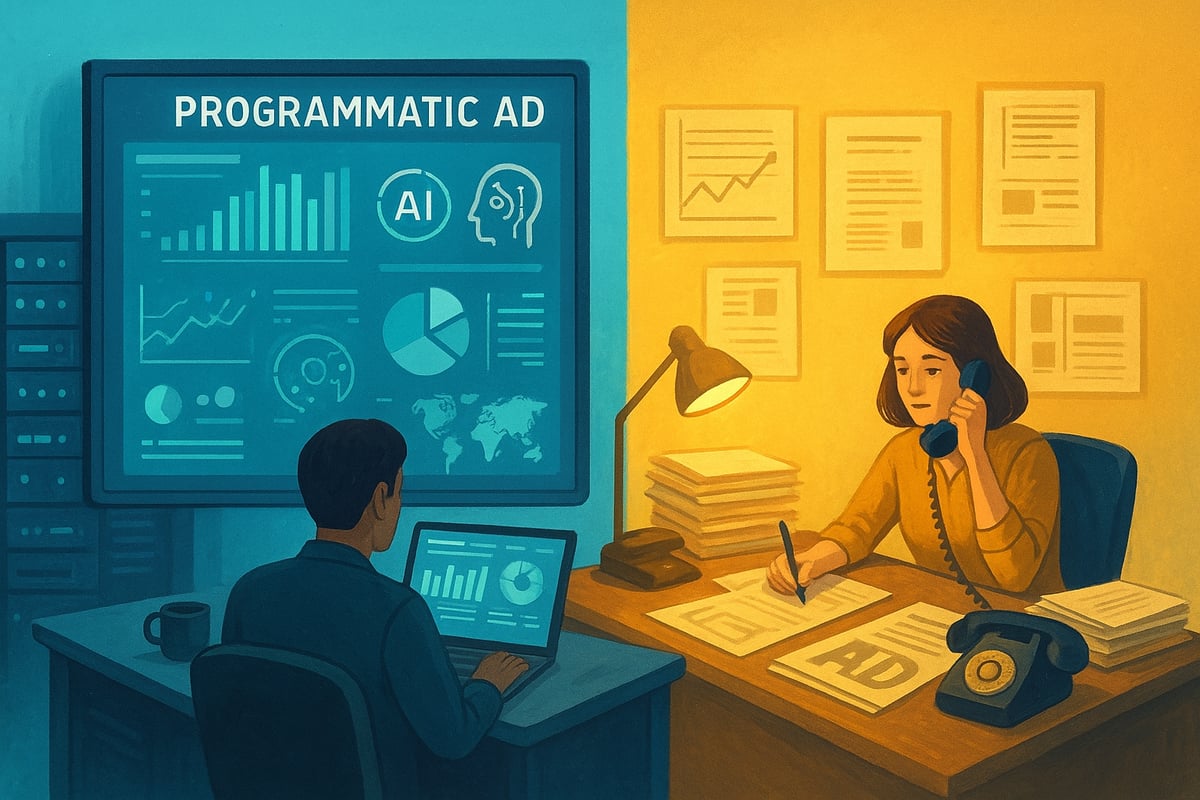
Choosing between google programmatic advertising and traditional ad buying is a pivotal decision for marketers in 2026. Each approach offers unique benefits and challenges, shaping campaign results in distinct ways. Let’s break down these two strategies across the most important dimensions.
| Dimension | Google Programmatic Advertising | Traditional Ad Buying |
|---|---|---|
| Inventory & Reach | Millions of sites, CTV, audio, DOOH | Limited, publisher/channel-specific |
| Targeting & Data | Hyper-targeted, multi-source data | Broad demographics, publisher data |
| Ad Formats | Dynamic, interactive, native | Standardized, less flexible |
| Buying Models | Auction-based, real-time, flexible | Fixed rates, upfront, less dynamic |
| Reporting | Real-time, granular analytics | Scheduled, less detailed |
| Resource Requirements | Technical, ongoing optimization | Manual, negotiation-heavy |
Ad Inventory and Reach
Google programmatic advertising unlocks access to millions of websites, mobile apps, connected TV, audio, and digital out-of-home screens. This massive scale makes it possible to reach both mass and niche audiences with precision. In contrast, traditional ad buying limits marketers to pre-negotiated deals with select publishers or broadcasters, restricting overall reach.
For example, a programmatic campaign can target specific interest groups across thousands of platforms instantly, while a traditional buy might only appear on a handful of chosen sites. According to Programmatic advertising statistics in the U.S., the number of unique publishers available to programmatic buyers has continued to surge, far outpacing traditional options.
Targeting and Data Utilization
A major advantage of google programmatic advertising is its ability to leverage first, second, and third-party data for highly granular targeting. Advertisers can reach users based on behaviors, interests, and intent, often retargeting across devices. Traditional ad buying, however, relies on publisher-provided audience profiles and broad demographic data, which limits targeting precision.
For instance, programmatic platforms allow brands to serve ads to users who visited their site, then retarget those users on mobile and CTV, something not feasible with manual buying. This data-driven approach often leads to higher conversion rates and improved ROI.
Ad Formats and Creative Flexibility
With google programmatic advertising, marketers can deploy dynamic, interactive, and native ad formats that adapt to user context. These formats enhance engagement and allow for real-time creative optimization. Traditional ad buying, on the other hand, typically sticks to standardized banners, print layouts, or TV spots, offering less flexibility.
Dynamic creative optimization in programmatic campaigns enables brands to test and swap messages on the fly, while fixed creative in traditional channels may not be as agile or personalized.
Buying Models and Pricing
Google programmatic advertising operates on auction-based models such as CPM, CPA, and other performance-driven pricing. This allows for dynamic bid adjustments and cost control. Traditional ad buying uses fixed rates, flat sponsorship fees, or negotiated CPMs, which lack real-time flexibility.
For example, if a programmatic campaign underperforms, bids can be adjusted instantly to optimize spend. Traditional deals are locked in with little room for mid-campaign changes, sometimes resulting in less efficient use of budget.
Transparency and Reporting
Transparency is a cornerstone of google programmatic advertising when using a reputable DSP. Marketers receive real-time, domain-level reporting and log-level data for deep insights. Traditional ad buying delivers scheduled reports, often with less detail and limited placement transparency.
With programmatic, advertisers can monitor performance and adjust campaigns immediately, while traditional buyers may have to wait weeks for campaign results and make changes only after the fact.
Management Complexity and Resource Requirements
Google programmatic advertising requires technical expertise, ongoing optimization, and data analysis, making it resource-intensive but highly adaptable. Traditional ad buying is more straightforward, focusing on relationship-building and manual negotiation, but is labor-intensive and less scalable.
Organizations often build in-house teams or partner with specialized agencies for programmatic, while traditional buys may still rely on established agency relationships. Both approaches demand unique skill sets and resource allocation.
Advantages and Drawbacks: When to Use Each Approach
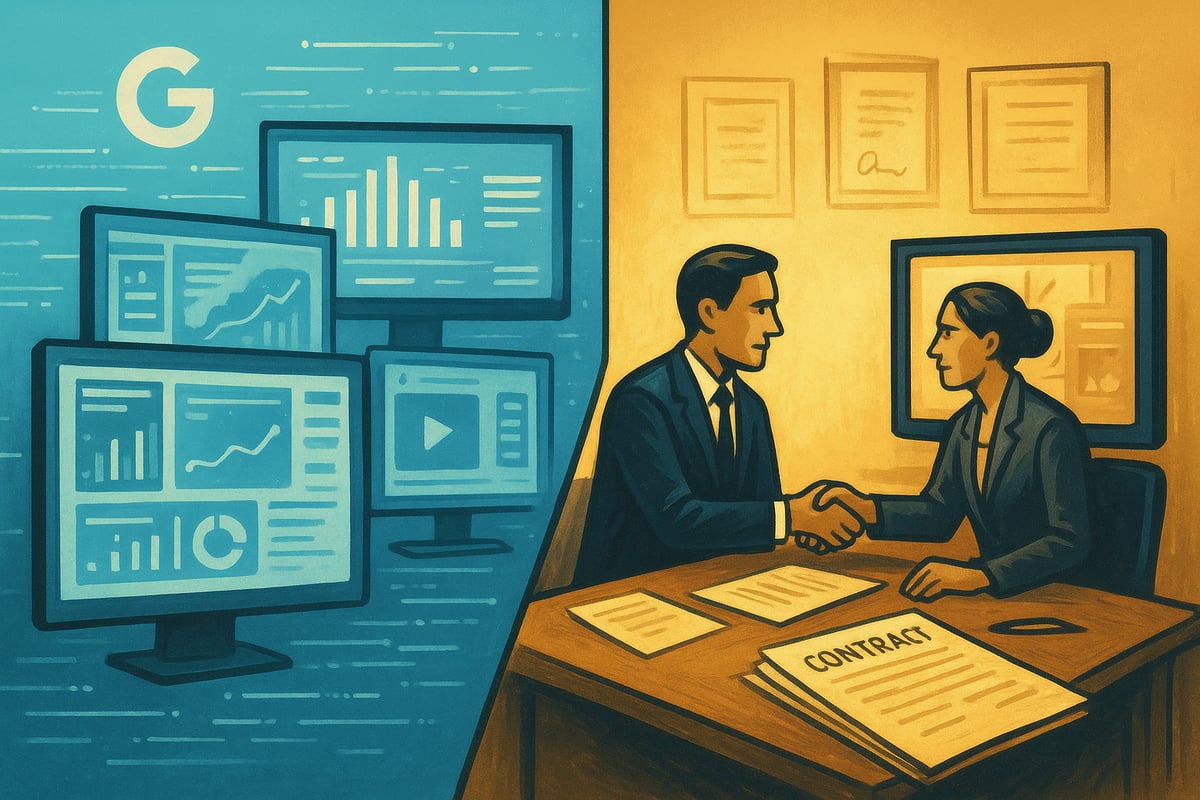
Choosing between google programmatic advertising and traditional ad buying can shape the effectiveness of your marketing campaigns in 2026. Each method offers unique benefits and presents specific challenges that marketers must weigh carefully.
Advantages of Google Programmatic Advertising
Google programmatic advertising stands out for its exceptional scalability and reach. Brands can target both broad and niche audiences across millions of websites, apps, CTV, audio, and DOOH inventory. This expansive access is powered by sophisticated data-driven targeting, allowing marketers to personalize campaigns using first, second, and third-party data.
Real-time optimization is another core benefit. Marketers can instantly adjust bids, creative, and targeting based on live performance data, ensuring maximum efficiency. Cross-channel integration enables unified messaging and measurement across digital touchpoints, streamlining complex campaigns.
- Scalability for large and niche campaigns
- Advanced audience targeting using diverse data sources
- Instant optimization for improved outcomes
- Seamless cross-channel execution and unified reporting
For instance, an omnichannel brand awareness campaign can leverage both CTV and display ads to reinforce messaging. According to Programmatic buying’s share of digital ad spend, programmatic’s share of global digital ad spend continues to surge, with marketers citing increased efficiency and stronger ROAS from google programmatic advertising in 2026.
Drawbacks of Programmatic
While google programmatic advertising offers advanced capabilities, it also introduces complexity. The learning curve can be steep, requiring skilled teams to manage platforms, analyze data, and optimize campaigns. Ad fraud and viewability issues remain concerns, as automated systems can sometimes serve ads in non-human or low-quality environments.
Brand safety requires vigilant controls, with the risk of ads appearing alongside unsuitable content if not managed properly. Initial setup costs, including technology fees for DSPs and data providers, can be higher compared to traditional buying.
- Steep learning curve for new users
- Potential for ad fraud and viewability problems
- Brand safety risks without proper safeguards
- Higher upfront costs for technology and data
A common challenge is combating click fraud and ensuring placement transparency. In 2026, a significant share of programmatic advertisers are investing in advanced anti-fraud solutions to protect their media spend, reflecting ongoing vigilance needed in the ecosystem.
Advantages of Traditional Ad Buying
Traditional ad buying continues to offer strong advantages for certain objectives. Marketers retain direct control over premium placements and sponsorships, often negotiating exclusive opportunities with trusted publishers or media owners. These relationships can unlock custom integrations, event sponsorships, or unique homepage takeovers.
The process also offers greater brand safety and contextual relevance. Advertisers know exactly where their messages will appear, ensuring alignment with brand values. Pricing and campaign delivery are predictable, with fixed rates or sponsorship fees.
- Direct control over placements and sponsorships
- Strong relationships for custom opportunities
- Brand safety and contextual alignment
- Predictable pricing and delivery
For example, a brand launching a high-profile product may secure exclusive content partnerships or event integrations. In 2026, a notable percentage of brands still prioritize traditional buys for major launches, valuing the assurance and visibility that this approach provides.
Drawbacks of Traditional Ad Buying
Despite its strengths, traditional ad buying faces clear limitations. Targeting options are limited, often relying on broad audience segments provided by publishers. Campaign activation and optimization are slower, with manual negotiations and longer lead times required for creative and contracts.
Performance data is less granular, making real-time adjustments challenging. This increases the risk of inefficiency and wasted ad spend, especially when compared to the automated precision of google programmatic advertising.
- Limited targeting and scalability
- Slow campaign activation and optimization
- Less detailed performance data
- Higher risk of inefficiency and wasted spend
For instance, national TV or print campaigns require significant planning and cannot pivot quickly based on results. Inefficiency rates among traditional buyers remain a concern in 2026, prompting many marketers to reevaluate their media mix.
Integrating Programmatic and Traditional Strategies: Best Practices for 2026
In 2026, the digital advertising landscape rewards marketers who skillfully blend google programmatic advertising with traditional ad buying. Integrating both approaches is essential for brands aiming to maximize reach, precision, and impact across every stage of the customer journey.
Full-Funnel Marketing: Combining Strengths
A hybrid approach leverages the unique strengths of both google programmatic advertising and traditional ad buying. Programmatic excels at driving awareness and engagement by targeting audiences across CTV, audio, and display, while traditional channels like TV and print build trust and premium brand presence.
For example, a brand launching a new product might combine programmatic CTV ads for wide reach with a high-profile national TV spot to cement credibility. This synergy ensures consistent messaging and smooth transitions between awareness, consideration, and conversion phases. Brands using both strategies report higher campaign effectiveness and stronger brand recall.
Data, Attribution, and Measurement Integration
Unifying data and measurement is critical for optimizing campaigns that span google programmatic advertising and traditional channels. Marketers should centralize analytics to track audience behavior, conversions, and engagement across all touchpoints.
Cross-channel attribution models help allocate credit accurately, revealing which tactics drive results. By analyzing data from programmatic campaigns, marketers can refine traditional buys for better performance. For example, insights from CTV impressions may guide print or radio placements, ensuring every dollar works harder. A unified dashboard streamlines reporting and supports smarter decision-making.
Budget Allocation and Optimization
Strategically splitting budgets between google programmatic advertising and traditional buying ensures resources align with campaign goals. Many brands start with a pre-set allocation, then shift funds dynamically based on real-time results.
| Channel | Average Budget Share (2026) |
|---|---|
| Programmatic | 62% |
| Traditional | 38% |
This flexible approach allows marketers to capitalize on strong-performing programmatic channels mid-campaign or double down on traditional placements for major events. Ongoing optimization ensures maximum return on investment and supports agile marketing strategies.
Overcoming Challenges in Integration
Integrating google programmatic advertising with traditional buying requires breaking down organizational silos and investing in both talent and technology. Collaboration between digital and traditional teams is vital. Regular cross-training sessions and unified planning tools help bridge knowledge gaps.
Brands succeeding in integration often use case studies and industry insights, such as those discussed in The Great PPC Shake-Up, to stay ahead of evolving best practices. In 2026, over 70% of organizations cite integration as a top priority, recognizing its role in driving unified, high-performance campaigns.
Future Trends and Predictions for Digital Ad Buying
As we look ahead, the digital advertising landscape is set for dramatic transformation. Marketers seeking to maximize results with google programmatic advertising must stay ahead of these trends to remain competitive.
The Ongoing Evolution of Programmatic Technology
The rapid evolution of google programmatic advertising is driven by advances in AI and machine learning. These technologies now power highly sophisticated targeting, real-time optimization, and automated creative personalization.
Programmatic is also expanding into new channels, including connected TV, digital audio, and digital out-of-home. As a result, the programmatic advertising market size is projected to surpass $4,397.68 billion by 2032, largely due to AI adoption and data-driven strategies, according to the programmatic advertising market size forecast.
This growth enables brands to deliver relevant messages at scale and adapt quickly to market changes.
Privacy, Regulation, and Data Changes
Privacy regulations like GDPR and CCPA are reshaping how google programmatic advertising targets users. With third-party cookies fading, first-party data and consent-based models are becoming the standard.
Contextual targeting is regaining importance, as marketers seek privacy-compliant ways to reach audiences. In 2026, over 60% of campaigns are expected to rely on first-party data as the primary targeting method.
This shift requires brands to invest in robust data strategies and transparent consent mechanisms to maintain effective targeting.
The Role of Automation and Human Expertise
Automation is now central to google programmatic advertising, handling everything from media buying to optimization and reporting. However, human expertise remains vital for strategic planning, creative development, and ensuring brand safety.
Programmatic guaranteed deals, which blend automation with negotiated terms, are becoming more common. In 2026, automated transactions are expected to account for nearly 80% of all digital ad buys.
Balancing technology and human insight helps brands achieve both efficiency and strategic alignment.
Convergence of Programmatic and Traditional Buying
The boundaries between google programmatic advertising and traditional ad buying are blurring. Traditional channels like TV, radio, and out-of-home are adopting programmatic methods, enabling unified campaign management across platforms.
Omnichannel platforms are streamlining the process, allowing marketers to coordinate digital and traditional buys from a single interface. Programmatic TV and DOOH are expected to see double-digit growth rates as part of integrated strategies.
This convergence empowers brands to reach audiences wherever they are, with consistent messaging and measurement.
Preparing for the Next Wave of Digital Advertising
To succeed in this evolving environment, marketers must prioritize agility, continual learning, and cross-disciplinary collaboration. Investing in data analytics, AI-driven tools, and unified attribution models will be critical.
Brands are increasingly building teams with expertise in both digital and traditional media, ensuring they can adapt to new formats and technologies. In 2026, technology investment in marketing is projected to rise by 15%, reflecting the need for advanced skills and tools.
Staying ahead with google programmatic advertising requires a proactive approach to skills and innovation.
As you navigate the evolving landscape of ad buying, it’s clear that balancing data-driven programmatic strategies with the proven strengths of traditional approaches can set your brand apart in 2026. If you’re wondering how to make the most of these options for your unique goals, you don’t have to figure it out alone. At The Creative Stable, we blend decades of expertise in branding, digital innovation, and campaign strategy to help you drive results that matter. Ready to discuss your next step or tailor a plan for your business? Let’s Connect