

In late October 2017, Gary Vaynerchuk walked onto a stage in Portland, Oregon, and delivered a keynote. Nothing about that is remarkable; he gives dozens of them a year. What happened next is the part worth studying. His team took that single talk, sliced it apart, and rebuilt it into more than 30 separate assets that went on to collect over 35,000,000 total views across more than 20 platforms. One idea. Thirty-plus pieces of content. Tens of millions of impressions. It’s recycling at its best.
For a small business owner staring at a blinking cursor every Monday morning, that story can feel like it belongs to someone with a film crew and a media empire. It does not. The mechanics behind it are completely reproducible, and they have a name: content repurposing. This is the discipline of building one strong, long-form asset and then systematically parsing it into the many smaller messages your audience actually encounters. Here is how to build that engine for yourself.
Why a Content Repurposing System Beats Making More
The instinct most teams have when growth stalls is to make more. More posts, more platforms, more pressure. It rarely works, and the data explains why. The real bottleneck is not volume; it is reach and repetition across a fragmented buyer journey.
Consider how people actually buy. Research has found that the average B2B buyer consumes 13 pieces of content before making a purchase decision, split between vendor-created and third-party material. Your prospect is not reading one definitive article and signing a contract. They are encountering you in fragments, a clip here, a stat there, an email weeks later, and slowly assembling a picture of whether you can be trusted.
Repurposing answers that reality without burning your team out. The approach is already near-universal among professionals. In a ReferralRock survey, 94% of marketers said they repurpose their content; the remaining 6% said they planned to start, and not a single respondent chose the “no, and we don’t plan to” option. In that same study, 46% of marketers named repurposing the strategy that brought the best results in leads and conversions, well ahead of the 33% who pointed to creating brand-new content and the 21% who favored updating old posts. If you have ever felt that posting daily is a treadmill, you are right. The teams winning are not running faster. They are extracting more mileage from each idea. We have made this same argument before on why you should stop posting more on social media and start posting smarter.
Step One: Build the Pillar Content
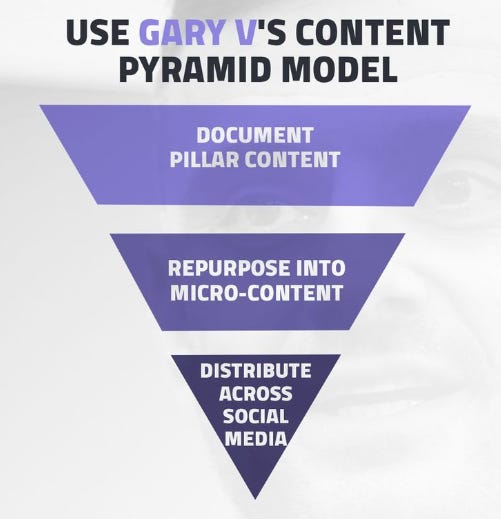
Everything starts with what Vaynerchuk calls a “reverse pyramid.” At the top sits one substantial piece of “pillar content,” and from it everything else is derived. For him that is a keynote or a vlog. For most small businesses, the most practical pillar is a thorough, genuinely useful long-form blog post or guide, something in the range of 1,500 to 2,000 words that answers a real question your customers ask.
The key is to write it to be taken apart. The Content Marketing Institute offers the perfect metaphor: build your pillar content like a Lego sculpture, so you can take it apart without breaking the bricks. In practice that means giving each section a clear, standalone subheading, building in quotable one-line insights, pulling out concrete statistics, and structuring your advice as discrete, numbered steps. A guide built this way is not one asset. It is a quarry.
Resist the urge to make it generic. A pillar piece that tries to say everything to everyone produces weak fragments. One that solves a single, specific problem produces sharp ones.
Step Two: Parse the Content Into Its Pieces
This is where one idea becomes 30. Work through your pillar guide and mine it for raw material. A single comprehensive post can reasonably yield a month or more of multi-channel content, and the breakdown looks something like this.
Social Content That Earns Attention
Each section heading becomes its own short post. Each statistic becomes a quote graphic. Each step becomes a carousel slide. The most valuable conversion here is video. According to HubSpot’s State of Marketing Report, the top three ROI-driving content formats are all video, led by short-form video at 49%, ahead of long-form video at 29% and live-streaming at 25%; short-form is also the single most-leveraged format marketers use. That is why turning your guide’s three best points into three 30-second talking-head clips is the highest-leverage move on this list. We dug into the reasons behind this in our blog post on why social media video content performs best. One blog post can comfortably generate 10 to 15 distinct social posts when you adapt the same ideas to the tone of each platform rather than copy-pasting.

Email and Ad Content
A meaty guide contains enough material to fuel a five-to-seven-part email sequence, with each message taking one idea, adding context, and nudging the reader toward action. The same headlines and statistics become the hook copy for paid social and display ads. You are not writing new ad concepts from scratch; you are testing lines that already proved compelling in long form.
Lead-Generation Content
This is the step most businesses skip, and it is where revenue hides. Repackage the actionable parts of your guide into a gated asset such as a checklist, template, or short workbook offered in exchange for an email address. The format matters enormously. An analysis of more than 41,000 forms by MailerLite found that the average sign-up form converts at 22.16%, with learning resources like checklists and tutorials averaging 27.4% and interactive tools 26.44%, far ahead of passive offers. A two-page checklist carved from your existing guide can outperform a 40-page ebook you spent weeks producing. If lead generation is your goal, our breakdown of how LinkedIn Premium helps small businesses get leads pairs well with this tactic.

Step Three: Run It Like a Content System
The difference between a one-time repurposing sprint and a durable content system is process. The principle underneath it is old and proven. In 2009, Daniel Jacobson, then Director of Application Development at NPR, coined the phrase “Create Once, Publish Everywhere,” or COPE, to describe building content once in a structured way so it could flow to any channel. As Jacobson put it, the idea is to “maximize the content creation and minimize the effort to distribute.” That philosophy is now the backbone of modern content operations.
Two habits make it work. The first is content batching: rather than creating one asset at a time, block dedicated sessions to produce many at once, which reduces the mental cost of constant context-switching and keeps your brand visible without daily scrambling. The second is staggering distribution. Do not dump all 30 pieces in one afternoon. Spread them across two to four weeks so a single idea quietly fuels a month of presence, with each fragment pointing back toward the original pillar.
The Content Marketing Institute makes one more point that should reshape how you plan: repurposing should begin in the planning stage, before the content is even created. When you sit down to write your next guide, you should already know the clips, emails, and lead magnet it will become.

My Proven Content Formula
Here’s a very simple way to parse content that works every time. First, write two very compelling pieces of content, usually for me that’s a blog post or guide that’s posted on the website. Then split it into 12 separate pieces of content that can be posted 3x a week for 4 weeks. That’s a whole month worth of content from one piece of quality content. It’s a formula I’ve been using for years and it works like a charm, every time.
The Takeaway
Vaynerchuk’s 30-plus pieces were never about working harder than everyone else. They were about respecting how much value sits dormant inside a single good idea. For a small business with limited hours and a lean team, content repurposing is not a clever growth hack. It is the only sane way to maintain a consistent, multi-channel presence without burning out. Build the pillar once. Parse it with intention. Distribute it like a system. One idea really can become 30 pieces of content, and the engine you build to do it will still be running long after the cursor stops blinking.
______________________________

About the author: Jennifer Frazier is a seasoned brand strategist, creative director, and senior copywriter with 30+ years of delivering high-converting results for the brands she and her team serves at The Creative Stable, a full-service advertising agency located in Dade City, Florida that she founded in 1990.