

Think about the last advertisement or blog post that really grabbed your attention. Chances are it wasn’t a list of product features or statistics – it was a story. We humans are wired for storytelling; it’s how we’ve shared knowledge and experiences for millennia. So when it comes to content marketing, it makes sense that weaving a human narrative into your brand message can be a game-changer.
 As a creative director, senior copywriter, and Certified StoryBrand Guide, I’ve seen firsthand how a compelling story can transform bland marketing copy into content that sparks emotion and inspires action. In this post, let’s dive deep into why human storytelling is so powerful and how you can harness it using the popular StoryBrand framework to clarify your brand messaging.
Why Storytelling Matters in Content Marketing
Stories stick in our minds in a way facts and figures rarely do. A classic study found that people remember 65–70% of information when it’s conveyed as part of a story, but only about 5–10% when it’s presented as plain facts. In other words, wrapping your message in a narrative can make it up to ten times more memorable for your audience. Facts tell, but stories sell. Our brains simply latch onto stories – they engage our senses and emotions, making the content much harder to forget.
Stories create an emotional connection, and emotions drive action. Rather than just informing, a good story makes people feel something, and those feelings can translate into trust and motivation. A recent survey found that 83% of consumers are more likely to buy from a brand when they feel emotionally connected to it. Whether it’s a story that inspires, tugs at the heartstrings, or even makes someone laugh, that emotional response can be the catalyst that nudges a person from casual reader to loyal customer. In fact, marketing research shows that storytelling in ads doesn’t turn people off it does the opposite: 92% of people want brands to create ads that feel like a story instead of a traditional sales pitch. When a narrative truly resonates with someone, it also inspires action. If people love a brand’s story, 55% will likely make a purchase in the future and 44% will share the story with others, essentially turning your audience into volunteer brand ambassadors. That’s the power of a great content marketing story at work.
Stories build trust and loyalty over time. By telling authentic stories about your customers, your founders, or your mission, you humanize your brand. You’re not just a company selling something; you’re a group of people with values and a vision that customers can relate to. Over half of consumers say they’re more likely to remember a story than a list of facts, and that memory often comes with a feeling of familiarity or trust. Companies that consistently share compelling brand stories have seen tangible boosts in customer loyalty (on the order of 20% higher loyalty compared to those without a clear story. And this isn’t just true for consumer audiences. A study by DemandBase found that 62% of B2B marketers say that storytelling is an effective strategy in their content marketing toolkit as well. In any context, a good story makes your message more relatable and credible, which in turn makes people more likely to stick around.
StoryBrand: A Storytelling Framework for Clear Brand Messaging
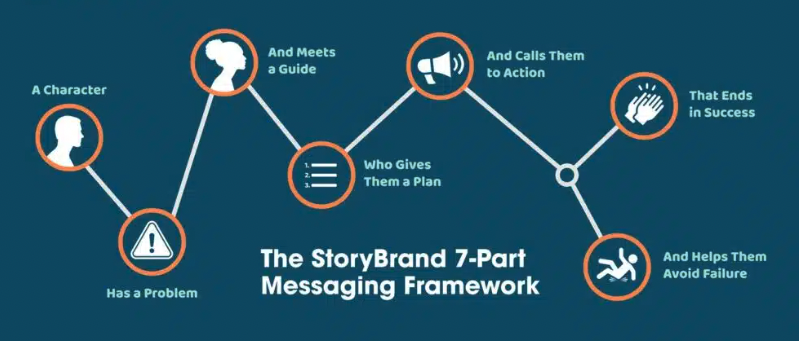
If storytelling is so powerful, how do we do it effectively in marketing? This is where the StoryBrand framework comes in. Developed by author Donald Miller, StoryBrand is a popular 7-part framework that applies the art of storytelling directly to your brand message. The genius of StoryBrand lies in one simple idea: make your customer the hero of the story, and your brand their helpful guide. By framing your marketing this way, you automatically speak to what your audience cares about – themselves – and how you can help them, rather than just talking about your company.
Every great story follows a familiar structure, and Miller distilled this into seven key elements for branding:
1 – A Character – the hero of the story, a.k.a. your customer, who wants or needs something.
2 – Has a Problem – a challenge or pain point that’s impeding the hero (external, internal, or philosophical problems they face).
3 – And Meets a Guide – that’s you, the brand. The guide (think Yoda to Luke Skywalker) has the experience and empathy to help the hero.
4 – Who Gives Them a Plan – a clear roadmap or solution. This is your product/service or the steps you propose to solve the hero’s problem.
5 – And Calls Them to Action – you prompt the customer to take action. It could be a purchase, a sign-up, a phone call – the point is to clearly invite them to act.
6 – That Ends in Success – the happy ending. Paint the picture of how your customer wins by following your plan (achieving their goal, relieving their pain).
7 – And Helps Them Avoid Failure – the stakes. Remind what’s at risk if the customer does nothing (missed opportunities or negative outcomes they avoid by taking action).
In essence, StoryBrand is about telling a simple, clear story where the customer is the protagonist and your brand plays a supporting role in their journey. As Miller bluntly puts it, “The hero of your brand’s story is not you, it’s your customer.” Your role is to be the wise guide with a plan to help the hero succeed. This shift in mindset has a powerful effect on your content: it forces you to speak to the customer’s needs and problems instead of just bragging about your product. By doing so, you automatically make your message more relevant and engaging to the people you’re trying to reach.
Crucially, the StoryBrand approach brings clarity to your marketing. It cuts out the fluff and focuses on a narrative that is crystal-clear to your audience. The human brain is hardwired to prefer stories, so when you communicate using this kind of narrative structure, your message becomes easier to understand and remember. (Ever notice how a confusing ad or website makes you tune out? StoryBrand prevents that.) In fact, one of the mantra phrases from the StoryBrand camp is, If you confuse, you lose. Clarity is everything. Miller notes that if you can tell a straightforward, customer-centered story across your marketing – on your website, in your emails, blogs, and social media – you will attract and engage more customers, and if you can’t, people will get confused and go elsewhere. This framework essentially gives you a storytelling blueprint so that all your content marketing speaks in one clear voice: a voice that says to the customer, “We understand your story, and we’re here to help you win.”

-
-
800% more leads from a clearer story. One fitness business in Australia revamped its marketing using the StoryBrand framework, focusing on the customers’ journey instead of generic gym promotions. The result? Their lead capture rate jumped from 2% to 18%, which was an 800% increase in leads. Even more impressive, new customer sign-ups quadrupled without increasing ad spend. In other words, the same marketing budget started working 8x harder, simply because the messaging was restructured as a clear, relatable story. By identifying a woman seeking a fitness solution as the hero and positioning the gym as her guide, they dramatically improved engagement and conversion.
-
“Unheard of” conversion rates. Story-powered content doesn’t just work for big campaigns, it can transform individual marketing assets too. Marketing expert Amy Porterfield discovered this when she rewrote her webinar registration page using StoryBrand principles. That page ended up converting 60% of cold traffic (people who had never encountered her before) into sign-ups. Sixty percent from a cold audience! Amy herself exclaimed that such a high conversion rate from cold ads was “unheard of”. What made the difference was the storytelling angle. Tthe page spoke to the visitor’s aspirational story of what they could achieve through her webinar rather than just pitching a product. By clearly showing the “hero’s” problem and how Amy could guide them to success, it resonated even with new visitors who had no prior relationship with her brand.
Big brands bet big on storytelling. Even global companies with massive budgets know that human stories outperform hollow marketing. Consider Nike – a brand practically built on inspirational storytelling. Nike’s famous “Dream Crazy” campaign featuring Colin Kaepernick is a prime example of the payoff of bold, narrative-driven content. This campaign wasn’t about shoes; it was about the story of courage and standing up for one’s beliefs. The response was huge. Dream Crazy generated an estimated $163 million in earned media, added a $6 billion increase in brand value for Nike, and boosted Nike’s sales by 31% globally. In winning hearts, Nike also won business. That’s the power of aligning your brand with a story that people connect with on a human level. It’s not just about advertising a product, it’s about championing a narrative your audience wants to hear and be part of.
-
These examples show that storytelling isn’t just fluff. It drives real, quantifiable results. When you clarify your message and strike an emotional chord, your content marketing works harder for you. You attract more leads, convert more prospects, and even build long-term brand equity. As one academic study on narrative marketing concluded, “implementing the StoryBrand approach in marketing was shown to make a positive difference in the success of an
“Unheard of” conversion rates. Story-powered content doesn’t just work for big campaigns, it can transform individual marketing assets too. Marketing expert Amy Porterfield discovered this when she rewrote her webinar registration page using StoryBrand principles. That page ended up converting 60% of cold traffic (people who had never encountered her before) into sign-ups. Sixty percent from a cold audience! Amy herself exclaimed that such a high conversion rate from cold ads was “unheard of”. What made the difference was the storytelling angle. Tthe page spoke to the visitor’s aspirational story of what they could achieve through her webinar rather than just pitching a product. By clearly showing the “hero’s” problem and how Amy could guide them to success, it resonated even with new visitors who had no prior relationship with her brand.organization…communicating a clear and compelling story and implementing it through all areas of marketing and messaging is key to seeing those positive impacts. In short: storytelling works.

Incorporating Storytelling into Your Content Marketing Strategy
So, how can you infuse more human storytelling into your own content marketing? Whether you adopt the full StoryBrand framework or just its general principles, here are some tips to get you started:
-
Know Your Audience’s Story: Great storytelling in marketing starts with empathy. Take the time to understand your customer’s world, their challenges (“villains” or problems), their goals, and what a happy ending looks like for them. What keeps them up at night? What do they aspire to? By pinpointing these elements, you can craft content that speaks directly to their story. Your customer should see themselves in the narrative you’re telling.
-
Make the Customer the Hero: It bears repeating…position the customer (not your company) as the hero of every piece of content. Tell stories where someone like them overcomes an obstacle or achieves something meaningful. Your brand plays a supporting role as the guide or tool that helps them get there. For example, instead of writing a case study that’s essentially “Look how great we are,” frame it as, “Here’s how our client (a person like you) went from struggle to success.” This subtle shift makes your content instantly more relatable and inspiring.
-
Keep It Simple and Clear: When using storytelling in content marketing, clarity is vital. Don’t let creativity cloud the core message. Outline the problem and solution in plain terms. Avoid jargon or overly complex plots. Remember, if people have to work to figure out what you’re saying, they’ll likely move on (after all, confused customers do tend to ignore confusing messages). A clear, straightforward story will always beat a convoluted one. Stick to the key beats of the narrative of who, what, how and make sure your audience knows exactly what role they play and what action you’re inviting them to take.
-
Be Consistent Across Channels: Once you’ve defined your brand’s core story (often by creating a StoryBrand BrandScript or similar narrative brief), use it everywhere. Your website, blog posts, social media content, videos, and even sales decks should all sing from the same hymn sheet, story-wise. This consistency reinforces the message and builds recognition. A cohesive narrative across all touch points prevents any disjointed experience. In fact, research suggests that the best results come when you thoroughly implement your story in all areas of marketing, ensuring every piece of content aligns with that clear narrative. So, whether someone reads an ebook or watches an Instagram Reel from you, they should always hear a harmonious story about how you help heroes like them.
-
Show, Don’t Just Tell: Incorporate real human elements into your content. Customer testimonials, case studies, or behind-the-scenes anecdotes can bring your story to life. Featuring real people and real experiences makes your narrative more authentic (and audiences respond to authenticity). Sixty-six percent of consumers say the most engaging brand stories are about regular, everyday people rather than fictional scenarios or purely aspirational figures. So highlight your customers’ stories and successes. Use vivid examples or even visuals that put a human face to your message. This not only strengthens the emotional impact of your content, it also builds trust that you can deliver on your brand’s promises in the real world.
By following these steps, you’ll start to see your content marketing shift from just publishing information to truly communicating in a way that resonates. Each blog post, email, or video becomes an opportunity to reinforce your narrative and deepen the connection with your audience.

Putting Story at the Heart of Your Content Marketing
In today’s noisy market, it’s the human touch that often makes the difference. The bottom line is that human storytelling isn’t just a feel-good add-on for your marketing. it’s a proven strategy to make your content more engaging, memorable, and effective. We’re all bombarded with information daily, but a well-told story cuts through that clutter. Brands that embrace storytelling and frameworks like StoryBrand to keep it sharp are seeing the results in higher conversions, more loyal customers, and content that actually gets noticed and remembered.
The StoryBrand framework in particular is a powerful tool to ensure your brand’s story is on point. It gives you a clear roadmap to follow. Namely, clarify who your customer is, what they need, how you guide them, and what success looks like. By getting crystal clear on these elements, you create a foundation for all your content marketing. Your blog posts, your social media, your webinars, everything will consistently reinforce the same core story. And consistency breeds trust. When your audience consistently hears a narrative that resonates with their own goals and challenges, they start to view your brand as an ally in their personal story. That’s a pretty awesome place to be.
So, as you craft your next piece of content, ask yourself: What’s the story here, and who’s the hero? Shift the spotlight onto your customer and tell a tale of how they triumph (with a little help from you). The more you do this, the more you’ll see your messaging fall into place and your content marketing start to truly connect.
Ready to start telling your brand’s story in a way that captivates? Don’t be afraid to get personal and be creative, your audience is waiting to be inspired. And if you need help finding or refining that story, reach out to us at The Creative Stable. We love helping brands discover their unique voice and build messaging that resonates. Whether you want to implement the StoryBrand framework or just amp up the human factor in your content marketing, we’re here to guide you. Let’s make your customer the hero of a story they won’t forget – and watch how it transforms your marketing results.